FOSTERING CRITICAL THINKING IN BIVARIATE DATA ANALYSIS INSTRUCTION FOR SENIOR HIGH SCHOOL TEACHERS IN NGANJUK REGENCY
DOI:
https://doi.org/10.38040/jcore.v2i1.1227Abstract
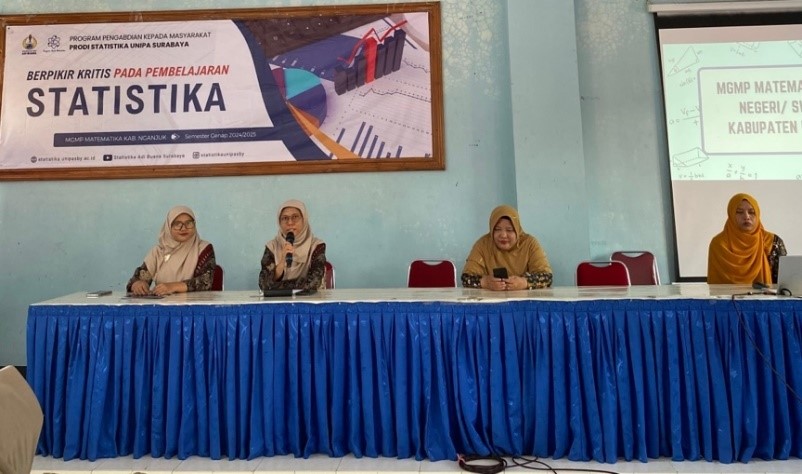
Statistics education is a vital component of the learning process, particularly in fostering logical, analytical, and quantitative thinking skills. Within this context, critical thinking plays a crucial role. Critical thinking is defined as the ability to objectively analyze information, evaluate arguments, identify assumptions, and draw logical conclusions. The development of critical thinking skills in statistics education aligns closely with the demands of the 21st century. This seminar aims to positively impact educators and students, specifically high school teachers in Nganjuk Regency, through the subtopic "Critical Thinking in Bivariate Data Analysis Learning." This theme was selected due to its high relevance to contemporary needs and its potential to provide extensive insights for teachers regarding the importance of critical thinking in statistics education, especially bivariate data analysis. The seminar's objectives extend beyond providing technical knowledge, aiming also to cultivate a critical mindset among teachers. The seminar activities include preparatory stages, theoretical and practical approaches, case studies, and interactive sessions such as question-and-answer and feedback discussions designed to achieve the seminar’s primary goals. Throughout these phases, the seminar enhances teachers' understanding of the importance of raising awareness and developing students’ critical thinking skills in statistics education. Consequently, teachers can more effectively foster students' critical thinking abilities through statistics learning.
Keywords: Critical Thinking; Bivariate; Learning; Community Service; High School