The Influence of Employee Workload on the Performance of HIV/AIDS Counseling Program Employees at the Kediri Regency Community Health Center
DOI:
https://doi.org/10.38040/js.v18i02.1514Abstract
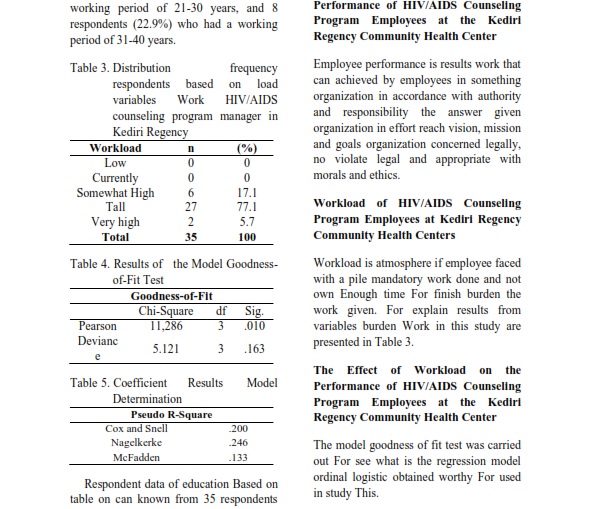
Introduction: The Community Health Center is a health service provider that provides promotive public health efforts. One of the promotive programs implemented by the Community Health Center is the HIV/AIDS counseling program. In its implementation, problems were found that caused the HIV/AIDS counseling program not to meet the target, namely the lack of human resources. Not infrequently, officers in charge of the program have concurrent duties, so that the focus on the counseling program is divided and has an impact on the achievement of targets that are not optimal. This study aims to analyze the effect of the workload of community health center officers on the performance of HIV/AIDS counseling program employees at the Kediri Regency Community Health Center in 2025.
Methods: The design of research is quantitative using a cross-sectional approach and the sample in this study were all population from employees of the HIV/AIDS counseling program at the Kediri Regency Community Health Center, totaling 35. Data collection in this study used an open questionnaire with measurements using a Likert scale and analyzed using ordinal logistic regression.
Results: The results of the regression model test showed a significant value of 0.05 so it was concluded that the workload can be significantly influenced by performance. The results of this study indicate a significant relationship between employee workload and the performance of community health center program employees.
Conclusion: Suggestions for community health center management include evaluating the work assigned to HIV/AIDS employees to ensure that the tasks assigned/assigned align with the capacity and expertise of HIV/AIDS employees.
Keywords: Community Health, Performance and Workload
Downloads
Published
How to Cite
Issue
Section
Citation Check
License
Copyright (c) 2026 Fannidya Zeho, Aris Dwi Cahyono, Luluk Susiloningtyas , Suryono Suryono

This work is licensed under a Creative Commons Attribution 4.0 International License.
- The journal allows the author to hold the copyright of the article without restrictions.
- The journal allows the author(s) to retain publishing rights without restrictions.
- The legal formal aspect of journal publication accessibility refers to Creative Commons Attribution (CC BY).