A Correlation Study between Spirituality and Risky Sexual Behavior in Adolescents
DOI:
https://doi.org/10.38040/js.v17i2.1286Abstract
Introduction: Risky sexual behavior among adolescents is a significant public health concern due to its potential long-term consequences, such as unintended pregnancies, sexually transmitted infections, and psychological disorders. the spirituslity are believed to influence the likelihood of such behavior. This study aims to examine the relationship between spirituaity with risky sexual behavior among adolescents.
Methods: This research employed a descriptive analytic design with a cross-sectional approach. The population consisted of 1200 adolescents in SMA N 3 Lamongan, , totaling 369 respondents selected using cluster sampling. Data were collected through structured questionnaires and analyzed using Spearman Rho correlation test via SPSS.
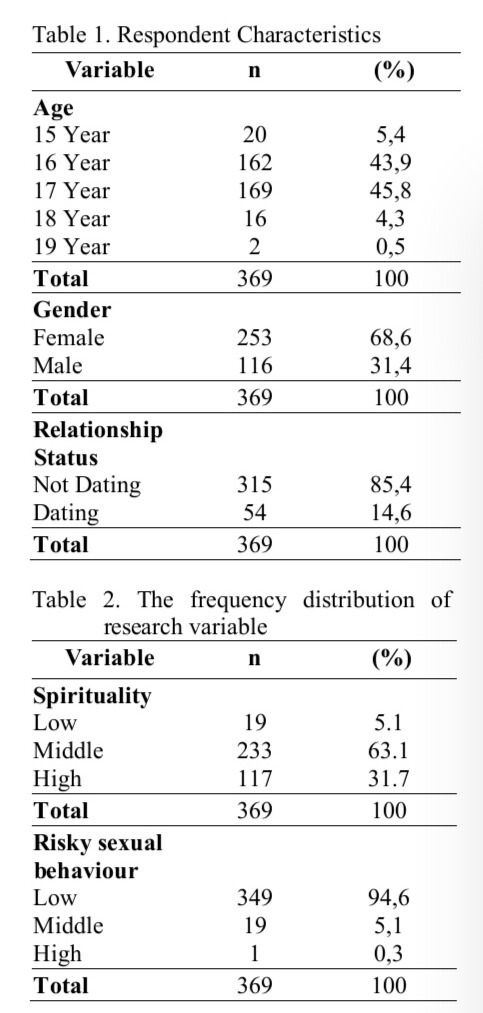
Results: The findings revealed that the majority of adolescents had a middle level of spirituality (63.1%) and risky sexual behaviour were categorized as low (94,6%). There was a very strong and significant relationship was found between spirituality and risky sexual behaviour (p = 0.001; r = -0.887), indicating that higher levels of religiosity are associated with a lower tendency to engage in risky sexual behaviour..
Conclusion: These results suggest that spirituality serves as a strong protective factor against risky sexual behaviour among adolescents, Religion-based interventions may serve as strategic approaches in efforts to prevent risky sexual behaviour in adolescents.Introduction: Risky sexual behavior among adolescents is a
significant public health concern due to its potential long-term
consequences, such as unintended pregnancies, sexually
transmitted infections, and psychological disorders. the
spirituality are believed to influence the likelihood of such
behavior. This study aims to examine the relationship between
spirituality with risky sexual behavior among adolescents.
Methods: This research employed a descriptive analytic design
with a cross-sectional approach. The population consisted of 864
adolescents,, totaling 369 respondents selected using cluster
sampling. Data were collected through SISRI-24 and Sexual
Behavior questionnaire and analyzed using Spearman Rho
correlation test via SPSS.
Results: The research results show that almost half of
respondents are 17 years old (45,8%) and most of them are
female (68,6%) and almost all of them are not dating (85,4).
The findings revealed that the majority of adolescents had a
middle level of spirituality (63.1%) and risky sexual behavior
were categorized as low (94,6%). There was a very strong and
significant relationship was found between spirituality and
risky sexual behavior (p = 0.001; r = -0.887), indicating that
higher levels of religiosity are associated with a lower tendency
to engage in risky sexual behavior.
Conclusion: These results suggest that spirituality serves as a
strong protective factor against risky sexual behaviour among
adolescents, Religion-based interventions may serve as strategic
approaches in efforts to prevent risky sexual behaviour in
adolescents
Downloads
Published
How to Cite
Issue
Section
Citation Check
License
Copyright (c) 2025 Inta Susanti, Masunatul Ubudiyah

This work is licensed under a Creative Commons Attribution 4.0 International License.
- The journal allows the author to hold the copyright of the article without restrictions.
- The journal allows the author(s) to retain publishing rights without restrictions.
- The legal formal aspect of journal publication accessibility refers to Creative Commons Attribution (CC BY).